The Azerbaijan State Conservatory named after Uzeyir Hacibayli, at present Baku Music Academy, has turned 96.
This higher educational hearth of music has passed a difficult path to achieve great prog ress and victories.
The Azerbaijan State Conservatory named after Uzeyir Hacibayli was established in accordance with the Decree of the Educational Department of the Peoples Commissariat of the Azerbaijan Republic dated May 25, 1920, in place of previously named Peoples Conservatory.
Thinking profoundly and seeing far ahead, Uzeyir Hacibayli strove to create another music educational hearth. This educational hearth aimed mainly at special music training to nurture specialists in all profiles. U.Hacibayli developed a detailed and accurate report for the Peoples Education Department that laid foundation for the program and the charter of the Azerbaijan State Conservatory with Uzeyir Hacibayli as its legal founder. The charter was signed by N.Narimanov, Chairperson of the People’s Commissars Council, and D.Buniyatzada, Peoples Education Commissar, after its approval by the Azerbaijan Government on August 21, 1921.
Music education in the Conservatory had 3 cycles: elementary, high and higher music education. The last stage named Music Academy was subordinated to the entire system of professional music education of the Republic together with its professors and teaching staff.
The Conservatories in Moscow and Petersburg found the charter created by U.Hacibayli useful and interesting to apply to. In 1928-1929 the Conservatory underwent structural changes - the separation of the first and second cycles. In their stead there were established several music and music technical schools. The Conservatory was considered as a higher music school. This structure has remained up to date.
In 1929-1930 the teaching pr ocess in the Conservatory was basically carried out by musicians from Baku, Moscow, Petersburg, Saratov of a non-Azerbaijani origin to include cellist L.V. Rostropovitch (father of M. Rostropovitch), composer and theory specialist L.Rudolf, pianist G.B. Sharoyev (one of Baku music schools is named after him), oboe player V. Knyazkov, French horn player and theory specialist S.Berolski, vocalists N.Speranski, N. Kolotova, V. Nikolski and many others.
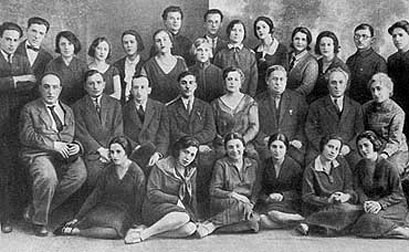
1930
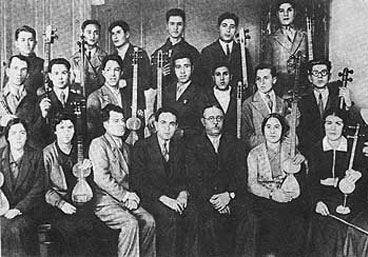
1932
- 1
In 1939 U. Hacibayli was officially appointed the chief of the Conservatory (since 1934 this position had been renamed to the director). Till the end of his life he remained the chief of the Conservatory.
In 1939 the Conservatory moved to its own beautiful architectural building where it was housed as a higher music educational hearth of the Republic.
In the late 1930 in an effort to improve the quality of education the Conservatory sent the most talented and promising students to Moscow Conservatory named after Tchaykovski. Acclaimed composers of the XXth century Q.Qarayev, C.Haciyev were the graduates of famous D. Shostakovitch’s class.
Holding training sessions to acquire highly qualified staff was one of the priorities for the Conservatory so that they could be placed at the school’s chair after graduation.
The years of the World War II were critical in the life of the Conservatory. Along with maintaining teaching traditions U. Hacibayli carried out his activity under the motto “Everything for the Front.” The building of the Conservatory was used as a hospital. U.Hacibayli was selected as a chief of the military commission; in this position he managed to organize hundreds of concerts for soldiers, featuring professors and students of the Conservatory.
After U.Hacibayli passed away Q. Qarayev took over the Conservatory. He became the leader of music cultural art of Azerbaijan. Talented tutor Q. Qarayev designed a new composer school carrying out the fusion of Western and Eastern music traditions. His school was presented by A.Malikov, V.Adigezalov, X.Mirzazada, F.Qarayev, I.Hacibayov, F.Alizada and others.
The next stage of the Conservatory begins from 1991 when F. Badalbayli, its Rector, put enormous efforts into the national performing art to reach out to the audiences worldwide. Since 1991 the Rector of the Azerbaijan State Conservatory has been professor F. Badabayli, Peoples artist of the USSR and Azerbaijan.
Badalbayli’s progressive and insight thinking made a positive impact on the renewal of the Conservatory’s activity. As the adherent of the traditions introduced by genius U. Hacibayli, he opened the new stage characterized by energizing creative processes, and broadening relations with international music audiences. In 1997, at the invitation of F. Badalbayli M. Rostropovich, one of the world’s renown cellists and our compatriot, was the guest of the Baku Music Academy.
He made the decision to travel to Baku to give concerts and conduct master classes annually. His visits in 1998, 1999, the 2000-2022s were so remarkable that the students and professors looked forward to welcoming maestro’s concerts and master classes.
The highlight of 1998, 1999, 2001 was the tour of Bella Davidovitch, bright pianist, and her son Dmintri Sitkovetski, violinist and conductor. In 1999 D. Sitkovetski gave a series of inspirational concerts with the European String orchestra at the Conservatory.
In 1991-2001 the Conservatory hosted a wide array of musicians - composers, theory specialists, cellists, pianists, violinists, wind instrument players from US, Germany, China, France, Russia, who gave concerts and exciting presentations on its stage.
Over these years the Conservatory pursued to organize prestigious contests and festivals like - 1994 - the first Republican U. Hacibayli’s contest of young musicologists;
- 1992 - the first Republican contest of organ players;
- 1998 - festival “Music of France and Azerbaijan;”;
- 2000 - joined with the German Embassy in Azerbaijan I. Bach’s festival of organ music;
- 1999 - the best concertmaster of the first Republican summer contest initiated by professor N. Ibrahimova, head of concertmaster’s art;
- 1996 – “The best pianist” contest sponsored by BP and AMOCO;
- 90s - Conservatory’s rector F. Badalbayli initiated the Republican violinist contest to promote professionalism demonstrated by young string musicians in international contests over the last years;
- 1997-2000 - Bul-Bul’s vocalist contest administered by I. Arkhipova and the board of jury comprising of prominent international musicians.
In 1991 there was created the scientific laboratory to help restore and improve ancient music instruments of Azerbaijan. In 1991-2001 BMA opened 3 new chairs: in 1992 – the chair of art history and theory, in 1995 - the organ and harpsichord chair, in 2000 -the mugham chair.
Nowdays BMA is dedicated to the pursuit of two major principles - loyalty and progress of Hacibayli’s traditions.
Over the last period BMA successfully implemented new projects and memorable events.
First of all BMA has made its best to introduce the Bolonga process into the educational system of 2004-2005 academic year. Compliance to the two-cycle higher education program in our education hearth was a big challenge as it required rebuilding the entire BMA teaching process over again. Having accepted the two-cycle education the BMA now offers the Bachelor’s degree program and 1,5-2year long Master’s degree program.
At first sight over the years implemented Bolonga education system could be viewed as stepping away from numerous rules and traditions. On the contrary, the subject education system has always been successfully utilized in teaching practice in combination with special customs and traditions, rules and various works in a creative way. That is why implementation of the new education process was fast and not problematic. The Bolonga educational system made an effective impact on student’s confidence and concentration during their performance, ability to protect their rights which can be viewed as a positive aspect of that period.
The highlight of the BMA’s history in recent years was a fundamental renovation of its building. The new building of the education hearth previously in serious need in big reconstruction was enthusiastically welcomed by everyone.
During the last years the BMA has strongly focused on setting up international relations through series of different events including concerts, contests, master classes, meetings, etc.
Maintaining these relations on one hand and broadening them on the other hand is very useful and important for young musicians as they tremendously help their professional development.
The relations between Azerbaijan and Norway are the vivid example as they made young Student’s participation in international contests possible. The contests provided the opportunity for students of BMA performing faculty and BMA Music Studio to present themselves and be among the winners.
As part of U. Hacibayli’s Baku Music Academy everyone beginning from the Rector, professors and ending up with students makes a resound contribution into the daily life flow of the school.